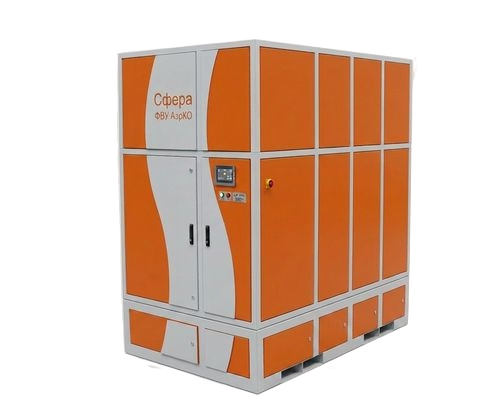
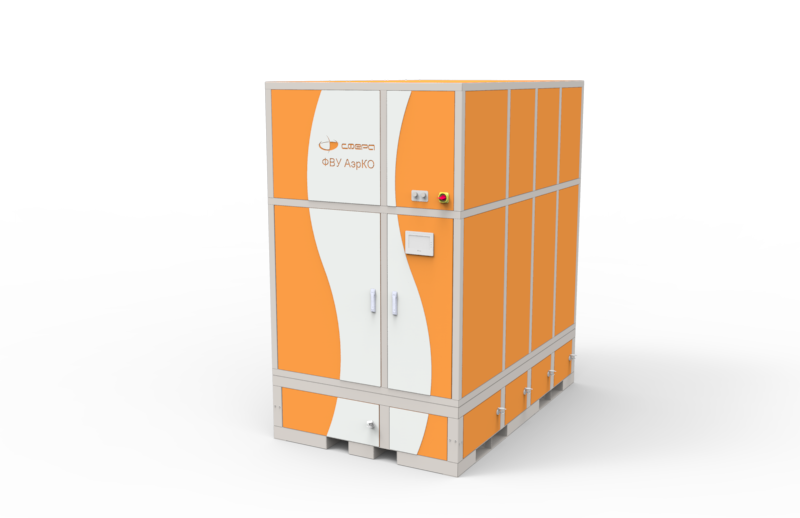
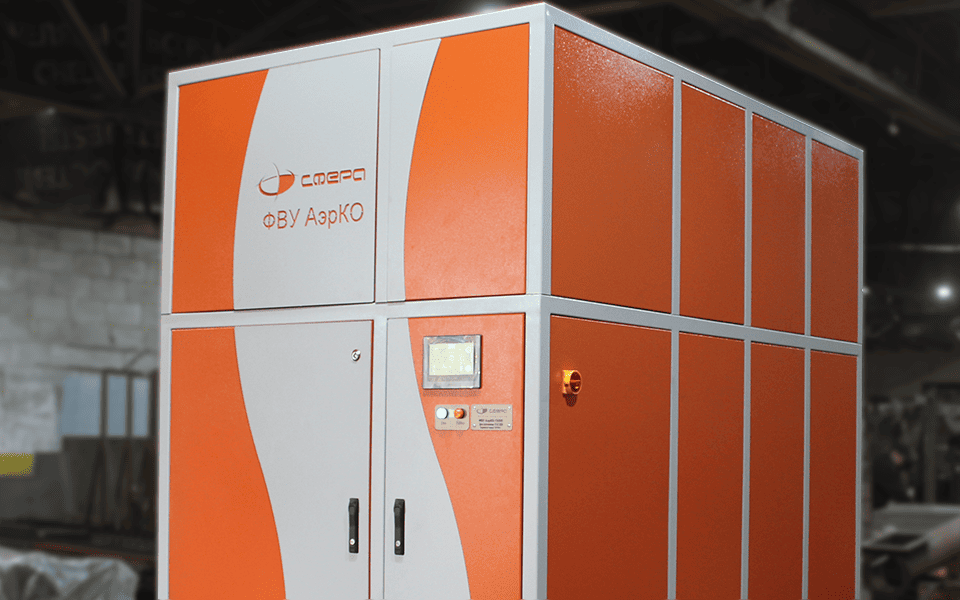
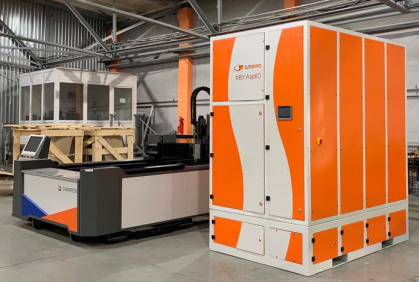
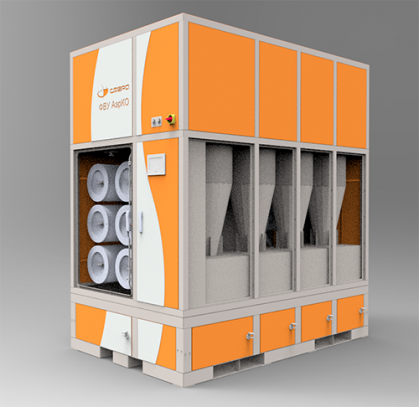
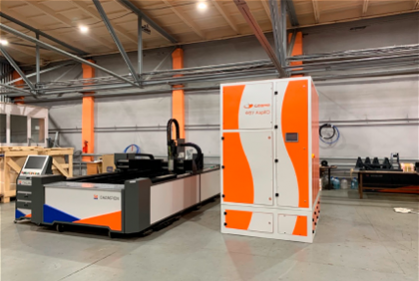
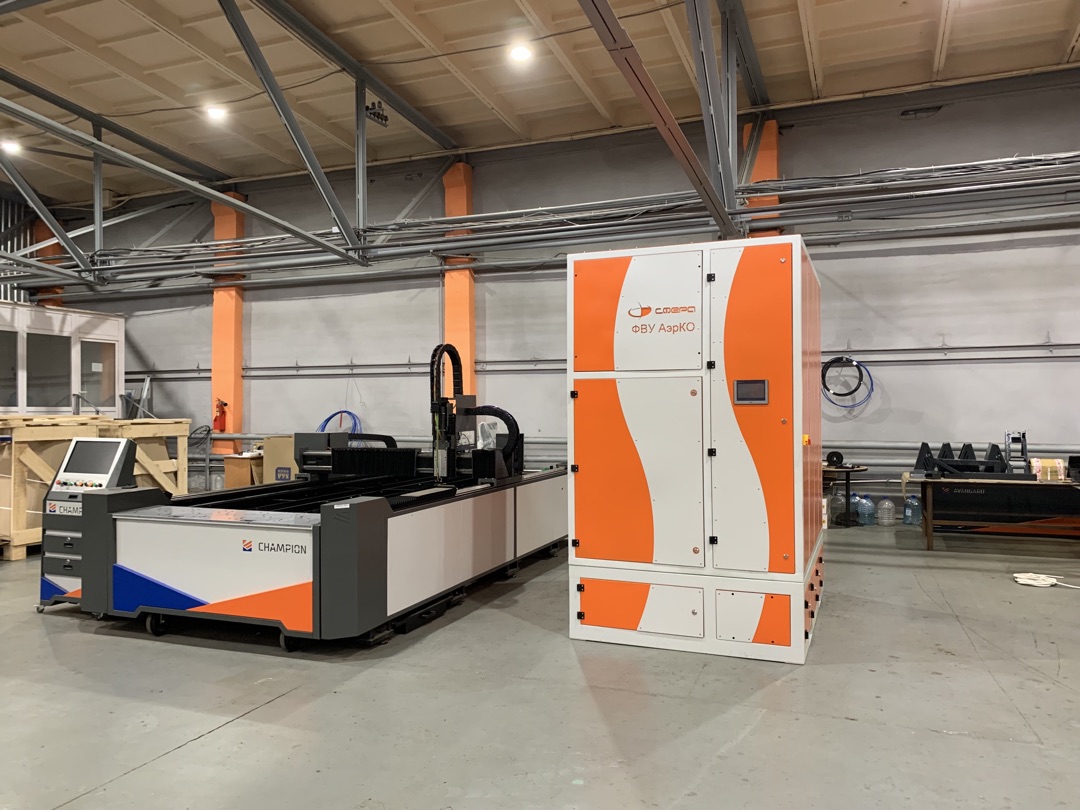
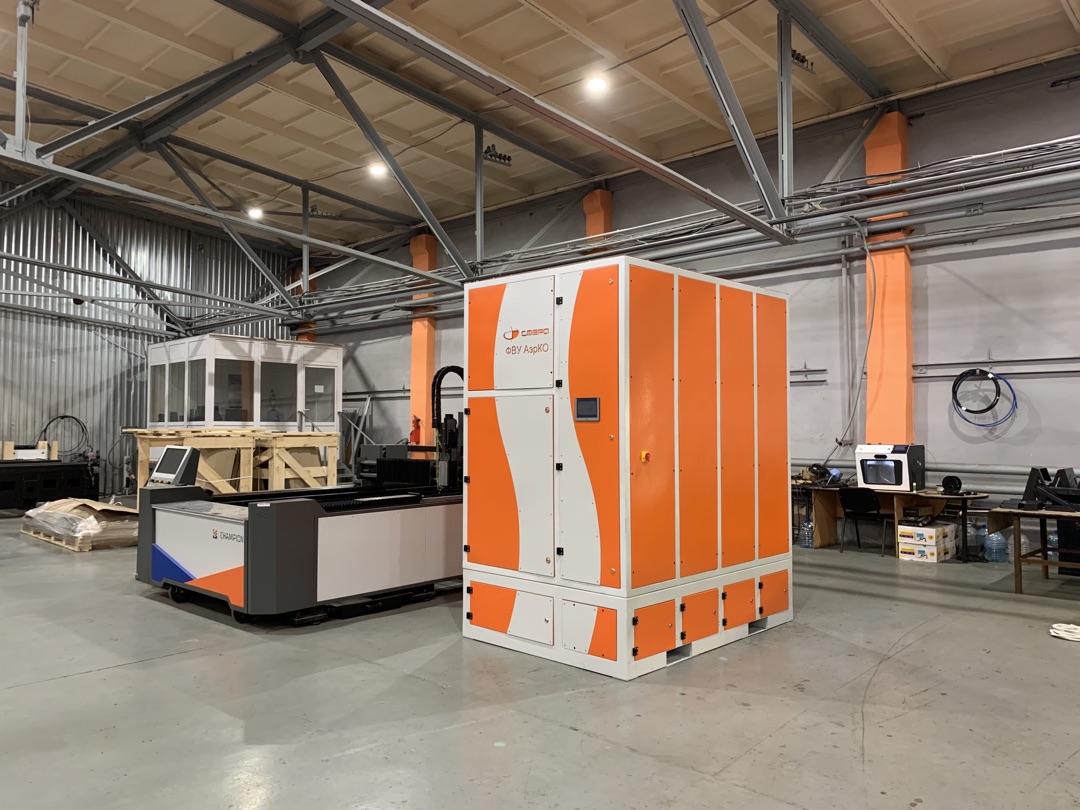
AerCO Turbo filter-ventilation unit
 In stock
AerCO TURBO 6000 FVU
For air purification during laser and plasma cutting, welding and abrasive processing of metals.
✔ Number of cyclone filters: 2 pcs.
✔ Number of cartridge filters: 4 pcs.
In stock
AerCO TURBO 8000 FVU
For air purification during laser and plasma cutting, welding and abrasive processing of metals.
✔ Number of cyclone filters: 4 pcs.
✔ Number of cartridge filters: 6 pcs.
RUB 1 390 000*
In stock
AerCO TURBO 10 000 FVU
For air purification during laser and plasma cutting, welding and abrasive processing of metals.
✔ Number of cyclone filters: 4 pcs.
✔ Number of cartridge filters: 6 pcs.
RUB 1 490 000*
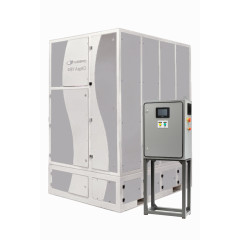
AerCO TURBO 10 000 explosion-proof FVU
1) Use of an antistatic coating;
2) Stainless steel hopper and cyclones
3) Explosion-proof equipment
4) Remote control cabinet
✔ Number of cyclone filters: 4 pcs.
✔ Number of cartridge filters: 6 pcs.
RUB 2 200 000*
Air purification in the AerCO TURBO FVU takes place as the air moves through the first and second stage filters. Because the operation of process equipment that is a source of polluted air (laser and plasma cutting machines, welding and abrasive equipment) may produce sparks – particles of metal heated to a high temperature – the first-stage filter of the FVU is FVU an aerodynamic chamber acts that, besides filtration, serves as a spark arrestor.
The aerodynamic chamber is a group of cyclone filters (cyclones) working in parallel. The design of the cyclones has been optimised using computer modelling to reduce their size and widen the range of flow rates at which the required filtration efficiency is achieved.
|
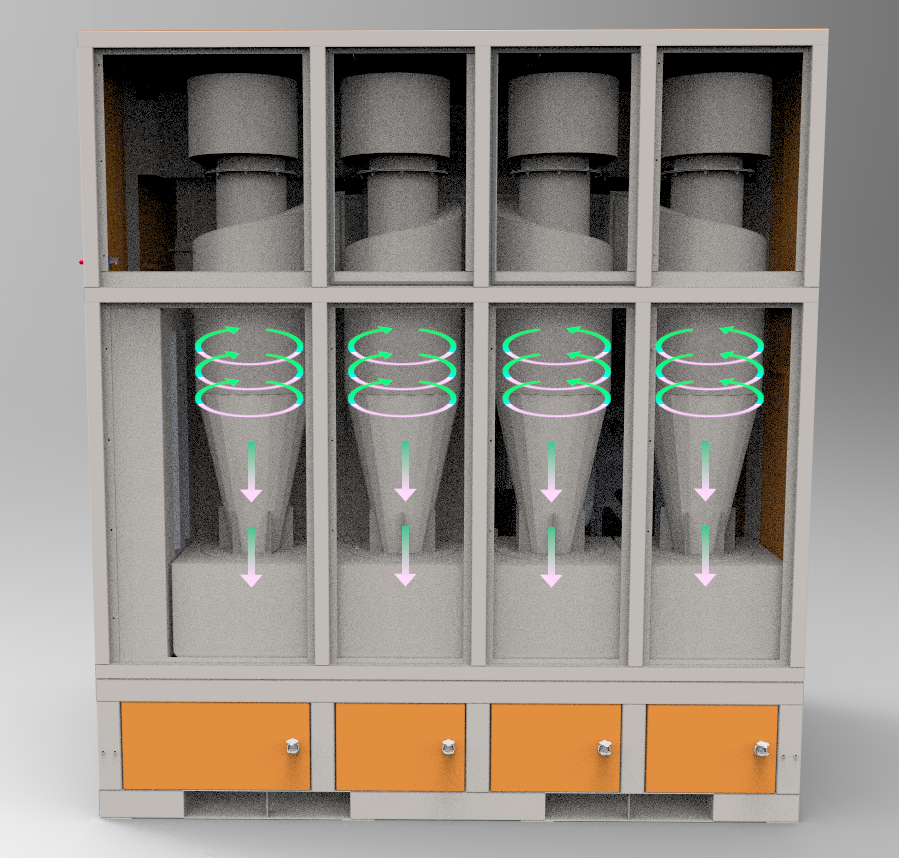 |
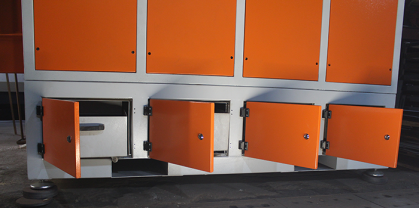
The AerCO TURBO FVU has anoriginal hopper design: each cyclone works with its own independent hopper. This prevents air flows from crossing between the cyclones, which increases the overall efficiency.
Thanks to the integrated design solutions, the aerodynamic chamber provides a purification efficiency of up to 95% for particles larger than 5 µm, which significantly exceeds the values typical of cyclone filters.
|
In addition, the aerodynamic chamber solves the task of pre-filtering oil smokethat arises, for example, during laser cutting of metal sheets covered with an oil film.
Polluted air is fed to the cyclones through a system of air ducts whose design:
–ensures even distribution of the air flow between all cyclones in the battery;
– prevents turbulent flows in the air stream;
–prevents the build-up of contamination on duct elements.
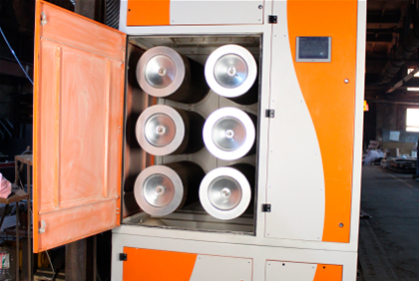
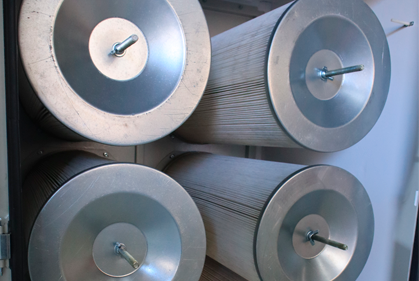
For high-quality air purification from particles smaller than 5 µm, the AerCO TURBO FVU uses second-stage filters – fine-filtration cartridge filters.
Contamination of the cartridge filters that occurs while the FVU is running is removed by blowing them with compressed air.
The cleaned air is discharged by the FVU through the outlet opening in the top wall of the FVU body.
AerCO FVU test results
Results of research (tests) and measurements of the chemical factor of the AerCO filter extraction unit - 6000/8000/10000 dated 30.01.2024
| Name of workplace, work area, factor |
Hazard class |
MAC |
Measurement results |
| Inlet air |
Outlet air |
% reduction of the harmful factor |
| Carbon monoxide mg/m3 |
4 |
20 |
4.58; 6.23 |
3.05; 5.20 |
33%; 16% |
| Nitrogen oxide mg/m3 |
3 |
5 |
0.25; 0.32 |
0.12; 0.2 |
52%; 37% |
| Manganese in welding aerosols mg/m3 |
2 |
0.6/0.2 |
0.5; 0.55 |
0.15; 0.26 |
70%; 52% |
| Nickel, nickel oxides, sulphides and mixtures of nickel compounds (matte, nickel concentrate and agglomerate, recycled dust from treatment devices) (as nickel) mg/m3 |
1 |
0.05 |
0.23/ 0.32 |
0.03; 0.048 |
86%; 85% |
| dichromium trioxide /as chromium (III)/ (chromium sesquioxide), chromium oxide mg/m3 |
3 |
3/1 |
2.76; 3.89 |
0.146; 0.23 |
94%; 93% |
| Manganese oxides /as manganese dioxide/ a) disintegration aerosol mg/m3 |
2 |
0.3 |
0.28; 0.46 |
0.14; 0.22 |
50%; 52% |
Results of measurements of predominantly fibrogenic aerosols (PFA) 6000/8000/10000 dated 30.01.2024;
| Name of workplace, work area, factor |
Hazard class |
MAC |
Measurement results |
Results of measurements for shift-average concentration values |
| Inlet air |
Outlet air |
% reduction of the harmful factor |
Inlet air |
Outlet air |
% reduction of the harmful factor |
| Dust (10%>SiO2>2), mg/m3 |
3 |
-/4 |
76.0; 81.0 |
3.17; 5.9 |
95%; 92% |
47.1 |
2.72 |
94% |
| diiron trioxide (iron(III) oxide) |
4 |
6 |
22.3; 39.9 |
0.96; 2.0 |
95%; 94% |
18.7 |
0.89 |
95% |
The measurement results are confirmed by a report from an independent accredited testing laboratory. To request the test report, follow the link and fill in the request form.
Filter-ventilation units for industrial machines: clean air and higher production efficiency
Industrial machines play a key role in production, but their operation can create various contaminants and dust in the air. This can harm workers' health as well as the efficiency and durability of equipment. However, modern filter-ventilation units can keep the air clean and improve the productivity of production processes.
A filter-ventilation unit is an innovative solution for cleaning the air of contaminants produced by machine operation. It provides effective filtration and removal of mechanical impurities, dust and other particles from the air, protecting workers and equipment from harmful effects. With filter-ventilation units, companies can create a safe and healthy working environment that raises productivity and reduces production risks.
Filter-ventilation units are designed for effective filtration of air from various contaminants. They are equipped with advanced technology that effectively removes dust, chips, material residues and other particles generated during machine operation. This not only improves air quality in the work area but also prevents contaminants from accumulating in ventilation systems and on equipment surfaces.
Clean air provided by filter-ventilation units creates a safe working environment for employees. Eliminating contaminants and dust significantly reduces the risk of allergic reactions, respiratory diseases and other problems associated with working at an industrial plant.